Jan 6
Historic site of transgender resistance up for local landmark status
Eliot Faine READ TIME: 3 MIN.
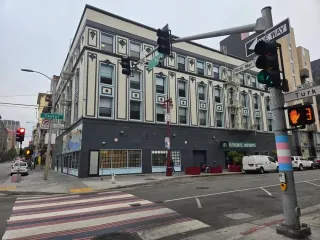
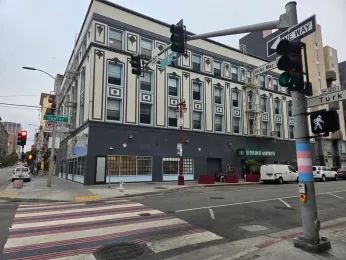
The San Francisco Historic Preservation Commission later this month will hold a public hearing at City Hall regarding the proposed historic designation of several local LGBTQ landmarks, including the site of the Compton’s Cafeteria Riots in the Tenderloin. Ultimately, it will be up to the city’s supervisors and mayor to grant local landmark status to the properties under review.
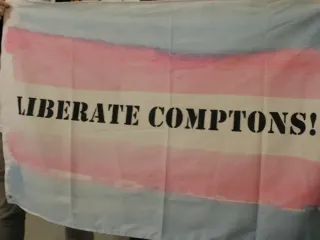
Local activist group Compton’s x Coalition initiated the community-sponsored nomination for the property that housed one of the earliest recorded acts of transgender defiance to police brutality in the nation. Made up of Tenderloin residents, scholars, and historians, the coalition is working through San Francisco’s appeals processes to oust current facility owner, private prison operator GEO Group from the building. The Florida-based company currently operates a reentry facility at 111 Taylor Street, the site of the former Gene Compton’s Cafeteria.
A city designated landmark affords safeguards under Article 10 of the San Francisco Planning Code, which declares the protection and perpetuity of culturally significant sites. For example, it protects the facade of a structure deemed a local landmark but does allow for substantial changes to its interior spaces to be brought before city oversight bodies for approval.
“Landmark expansion at 101-121 Taylor prevents demolition despite [state senator Scott] Wiener’s recent CEQA reform. Demolition of an Article 10 landmark requires discretionary approval and findings (including Certificate of Appropriateness for major changes),” architectural historian Shayne Watson, a lesbian, wrote to the Bay Area Reporter. She was referring to Senate Bill 607 , which waives regulations for state and local governments to review the state’s environmental law before approving projects.
Despite the building’s recognition on both the California and National registers, those classifications don’t offer protection like a city landmark would.
The city’s possible landmarking of the Taylor Street site comes ahead of the 60-year anniversary in August of the Compton’s Cafeteria riots, reportedly sparked by a drag queen tossing a cup of hot coffee in the face of the police officer who tried to arrest her without a warrant. The exact date has been lost to time, despite the efforts of historians and others to determine it.
That night in August 1966 at Compton’s marked one of the country’s earliest recorded acts of defiance by trans people against police brutality. The Compton’s riots occurred three years before the better known Stonewall riots in New York City in 1969, which are credited with the beginning of the modern LGBTQ rights movement.
Nearly a year ago, on January 27, 2025 , 111 Taylor Street became the first property granted federal landmark status specifically for its connection to the transgender movement in the U.S.
In 2022, the San Francisco Board of Supervisors declared the intersection in front of Compton’s, and the exterior walls of 101 Taylor Street, as the city’s 307th landmark . Because the bulk of the structure was not covered by the local landmark, local historians and preservation planners are concerned this leaves the site vulnerable to being torn down.
GEO Group has run the reentry facility for people released from incarceration out of the site for 36 years. GEO Group is currently the subject of Board of Supervisors hearings, looking into alleged human rights violations and the death of its former resident Melvin Bulauan
Tenderloin district Supervisor Bilal Mahmood, who initiated the investigation, requested to reconvene after November’s hearing to continue the process. The next hearing date has not yet been determined. The supervisors want to hear from the California Department of Corrections and Rehabilitation, as a main contractor with GEO Group, though officials with the state agency had declined to appear before.
As the district supervisor, Mahmood could have initiated the local landmarking process, which he had voiced support for doing. But he told the B.A.R. last year he didn't p[lan to do so, following the lead of the Compton’s Coalition members to decide when the community wanted to begin the process.
The landmark hearing is for the Historic Preservation Commission to consider initiating the landmarking process. If the commission votes to approve the nomination, there are several more steps before the landmark designation becomes official.
The San Francisco Historic Preservation Commission will hear this and other items on Wednesday, January 21, at 12:30 p.m. in Room 400 at City Hall, 1 Dr. Carlton B. Goodlett Place.