November 7, 2025
GEO Group faces tough questions at SF supervisors hearing over reentry facility
Eliot Faine READ TIME: 2 MIN.
A San Francisco Board of Supervisors panel heard emotional testimony from the family of a man who died outside a Tenderloin reentry facility as well as from the center’s operators. The building at the center of the controversy was the site of a 1966 riot sparked by trans people and drag queens fighting police harassment.
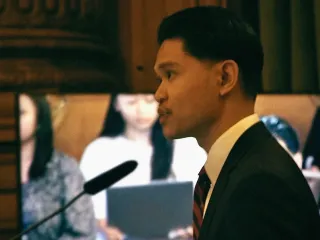
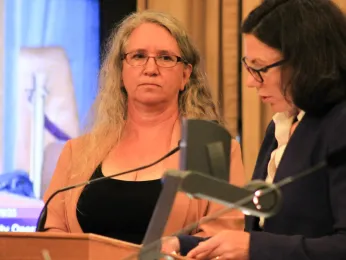
After more than three hours of testimony, questions, and public comment, District 5 Supervisor Bilal Mahmood, who represents the Tenderloin and had called for the hearing, asked for it to be continued to a later date. The Government Audit and Oversight Committee voted 3-0 to grant his request at its November 6 meeting.
Queer District 9 Supervisor Jackie Fielder, chair of the committee, was joined by Mahmood and District 3 Supervisor Danny Sauter. Committee member District 2 Supervisor Stephen Sherrill was excused. The panel’s next hearing date is yet to be determined and, with the board set to go on its winter recess in mid-December, may not take place until next year.
The private company GEO Group operates 111 Taylor Street, a reentry facility in the Tenderloin for formerly incarcerated people. Current and former residents, or “participants” as 111 Taylor Facility Director Maria Richard called them, have alleged delays in medical care, overcrowding, and “maggots in the food.”
Richard, who has worked at 111 Taylor Street for 25 years, denied there have ever been reports of maggots in food. Most of the food served at 11 Taylor Street is provided by an outside vendor, she said. Residents can bring in non-perishable food and have use of microwaves and toasters, she explained.
But she and Mahmood did get into a discussion concerning the presence of mice at the building. Richard said there is regular pest service provided.
“We are in the Tenderloin and there is an issue with vector control,” Richard said. “We don’t have any open complaints.”
“I live in the Tenderloin and I don’t have rodents,” Mahmood said, as Richard acknowledged that no one should have to live in a building with rodents.
GEO Group was also accused of having 14 residents in a room. Richard disputed that.
“We don’t have a room with 14 people in it,” she said.
This was the first time GEO Group has been requested to answer to the San Francisco oversight body.
Hearing long sought
Local historians, scholars, and activists known as the Compton’s x Coalition had prepared for this hearing since August . Several of their members had been former residents of 111 Taylor, and spoke to the treatment they received there.
Janetta Johnson, a Black trans woman and former 111 Taylor resident, said staff would refer to residents as “prisoner” or “inmate.” Johnson is now CEO of the TGI Justice Project, a nonprofit that works with formerly incarcerated trans and gender-variant people, mostly people of color. She also said that when she was there in 2012, residents had to pay fees.
Richard acknowledged that the fee policy is no longer in effect. Money that residents earn from outside jobs is saved for them and they receive the money when they leave. Richard said that residents who do have jobs are encouraged to save their money so that they have funds when they exit the facility.
Marcus Arana, also known as Holy Old Man Bull, a transmasculine Two Spirit Indigenous elder, used to work for the San Francisco Human Rights Commission between 2000 and 2010 as a discrimination investigator.
“They seem to have a disregard towards warnings and citations. Simply put, I believe GEO Group is acting with a sense of impunity, disregard to human safety,” Arana said during public comment, which was shared by Compton’s x Coalition Wilder Zeiser.
Mahmood called for the hearing after the July 14 death of former 111 Taylor Street resident Melvin Bulauan. He was found dead on the sidewalk, just up the street from the facility, after having been transferred there from Atascadero State Hospital the day before.
According to GEO Group , Bulauan’s parole officer had not been notified that he had left the facility.
Richard and MollyRose Graves, an executive with GEO Group, told the committee that they could not discuss specifics of Bulauan’s case due to privacy laws.
To Mahmood’s line of questioning, only some hypothetical, regarding Bulauan, David Blackwell, an attorney for GEO Group, said, “Supervisor, you know we’re not gonna talk about this specific case. Your office told us that we weren’t gonna get into this issue, and you’re doing it nevertheless.”
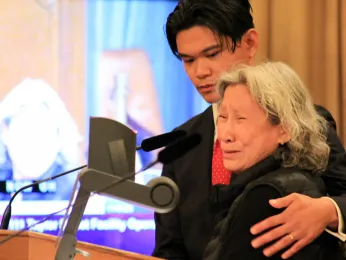
News of Bulauan’s death came to the Board of Supervisors from his son, Anjru Jaezon de Leon, back in July. Alongside his grandmother, Amelia Bulauan, de Leon took the podium to give public testimony Thursday.
“It was a place he was supposed to be safe,” Bulauan’s mother said through tears.
“I want my father’s story to matter. And I want this city to say that Melvin Bulauan’s life was worth more than a profit margin,” de Leon said.
The building at 111 Taylor Street in the city’s Tenderloin neighborhood is historic. The ground floor commercial space had housed Gene Compton’s Cafeteria, where one night in August 1966 a drag queen reportedly threw a cup of hot coffee in the face of a police officer who tried to arrest her without a warrant.
The exact date of the altercation has been lost to time. But the incident sparked a riot between trans and queer patrons of the 24-hour diner and San Francisco police, as detailed in the 2005 documentary "Screaming Queens" by transgender scholar and historian Susan Stryker, Ph.D.
Many of the allegations against GEO Group by Compton’s x Coalition involve civil rights violations and cultural and community harm, directly related to “transphobic abuse.”
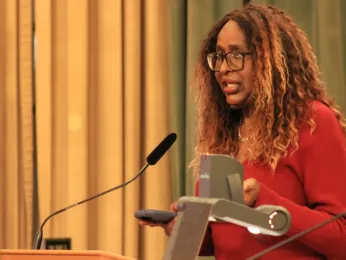
Johnson said that when transgender residents would report experiencing abuse, staff would “put them in the shu,” or special housing unit, referring to solitary confinement, for their “protection.”
She alleged that a staff member had attacked and sexually assaulted another resident, but that, fearing retaliation, attacks go unreported.
Fear of retaliation was a major theme at the hearing, though Richard denied this.
Richard said that residents’ gender identity is respected. “We do allow anyone who identifies as female to be on the female wing,” she said.
Mahmood pulled data from the Prison Rape Elimination Act reports, the purpose of which is to analyze the “incidence and effects of prison rape in federal, state, and local institutions and to provide information, resources, recommendations and funding to protect individuals from prison rape.”
The past year found 489 reports of sexual abuse and harassment involving detainees, inmates, and residents at GEO Group facilities nationally. The 2024 PREA report lists two ongoing cases of “staff on inmate” sexual abuse at 111 Taylor.
Richard said she could not talk about cases in progress. But she spoke of a “zero tolerance” policy at 111 Taylor around assault of a resident, that gives residents an “immediate” referral to medical and mental health outside the facility. Offending staff are placed on “administrative action.”
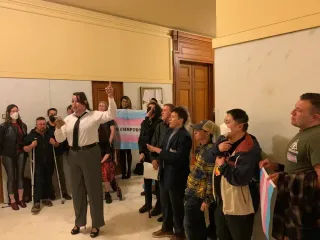
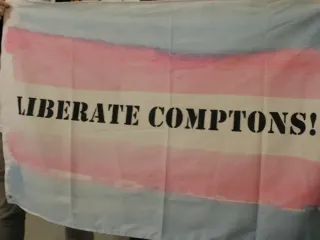
Santana Tapia, a spokeswoman of Compton’s x Coalition, gave a speech on the steps of city hall after the hearing, reaffirming the mission of the coalition to “liberate Compton’s.”
Though they were invited, officials from the California Department of Corrections and Rehabilitation declined to appear on Thursday before the oversight body. As one of the main contractors with GEO Group, the department will be asked to appear at the next hearing.
The other agency that contracts with GEO Group is the federal Bureau of Prisons. Two representatives, one from the U.S. Department of Probation and one from U.S. District Court, were present at the hearing and described how their agencies interact with GEO Group and 111 Taylor.
Silvio Lugo, chief U.S. pretrial officer at U.S. District Court for the Northern District of California, said there was a high level of oversight at 111 Taylor. He regularly brings new judges to tour the facility, as they often make decisions about whether someone can be referred there, he said.